
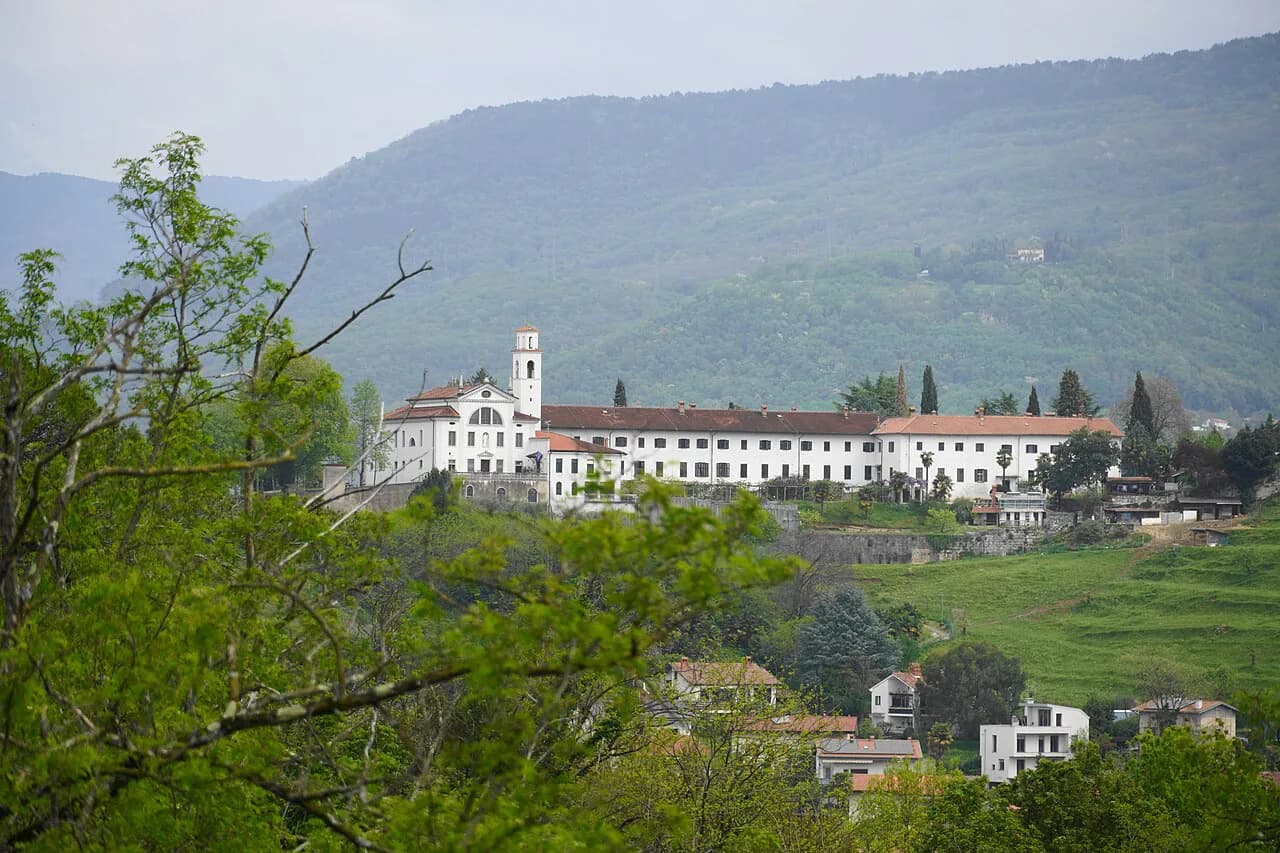
Kostanjevica Monastery: A Visitor's Guide to Nova Gorica's Hilltop Friary

Kostanjevica Monastery is a Franciscan friary on a hill above Nova Gorica, close to the Italian border at Gorica, and it holds three separate things to see: the church and monastery, the tombs of the Bourbon royal family in the crypt, and the monastery library. The wall of Bourbon roses on the southern facade is the seasonal draw, since thousands of them are in bloom in May and June. This guide covers each part of the hill, how to reach it, roughly how long to set aside, and what sits nearby.
Where Kostanjevica Monastery sits above Nova Gorica
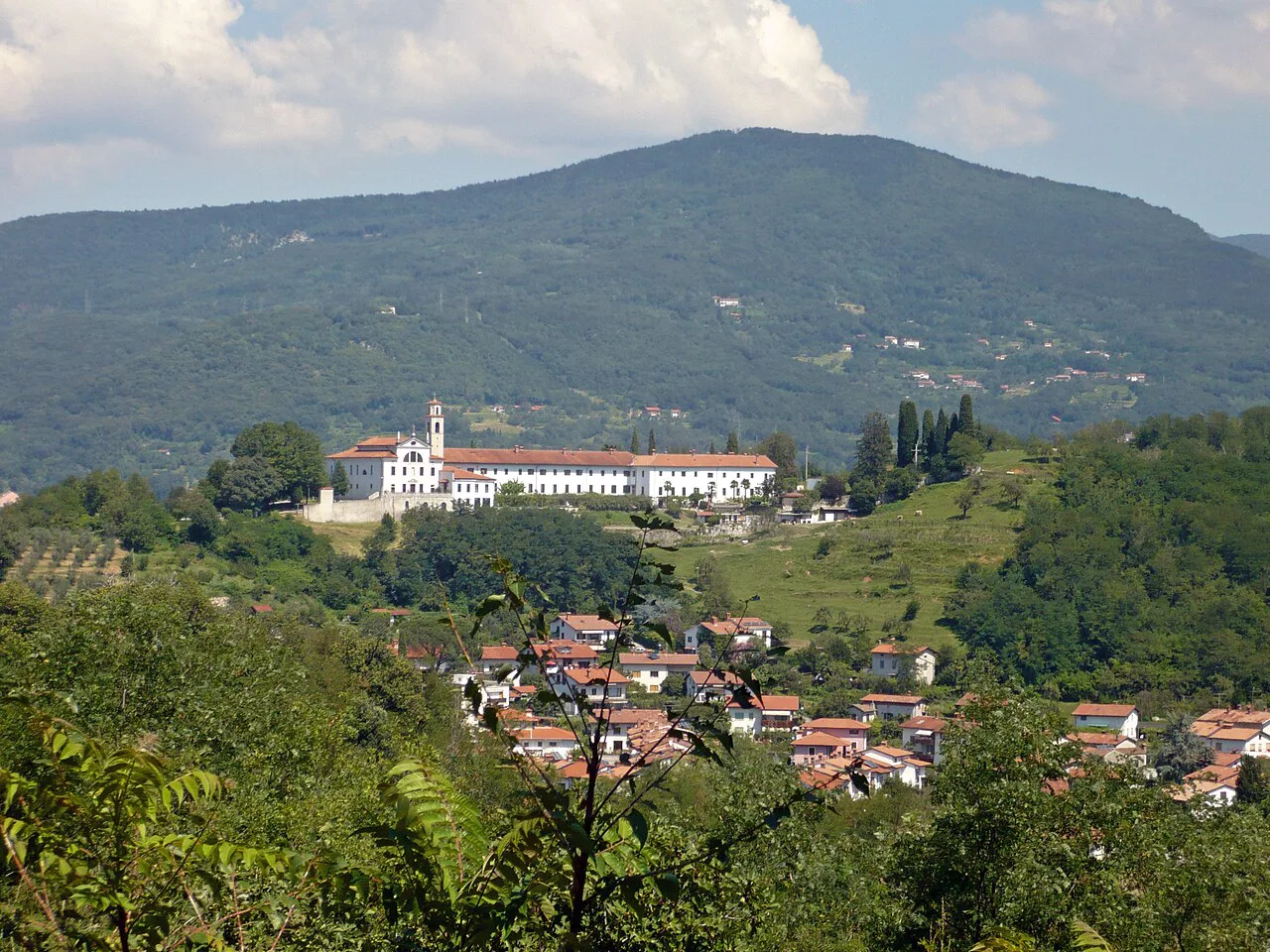
The monastery's address is Škrabčeva ulica 1 in Nova Gorica, and the friary occupies a hill between the Slovenian town and Gorica on the Italian side. The site works as a single stop rather than a district: church, crypt, library and rose garden sit together behind one gate, so you are not walking between separate addresses. Plan to arrive, work through the parts you want to see, and leave from the same point.
Because the friary is an active religious house rather than a museum with a ticket desk, the practical arrangements are best settled before you set out. Phone +386 5 330 77 50 or use the contact details on the monastery's own site to confirm when the church, crypt, library and rose garden can be seen on your dates. The friary publishes those arrangements itself, so ask about the specific day rather than relying on a general description.
Getting up the hill is short enough that most travelers treat it as a half-day anchor to a Nova Gorica day rather than a separate excursion. The town center, the border crossing and the other sights of the area all sit within easy reach once you come back down. If you are arriving by car, treat the friary as an early stop of the day and walk the town afterward.

The church and the Bourbon tombs in the crypt
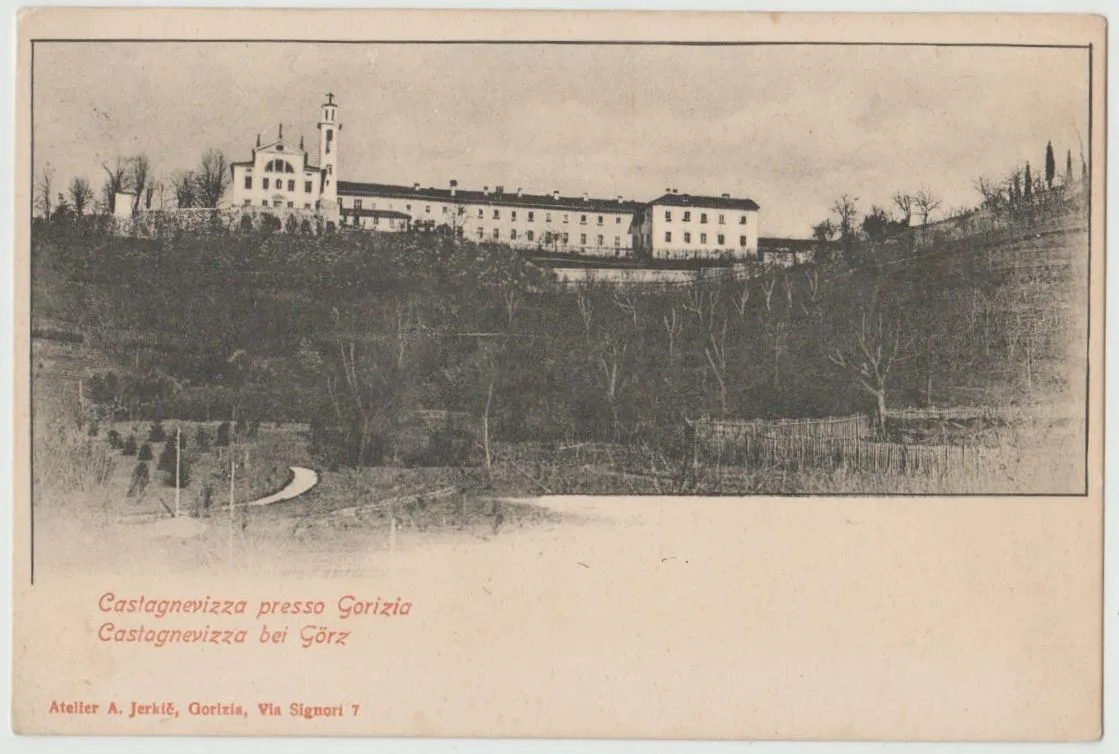
The heart of the visit is the church and the Franciscan monastery attached to it, which the friars have maintained as a place of ecclesiastical art and spirituality for nearly two centuries. The complex also functioned as a parish and, between 1950 and 1964, as the headquarters of the Apostolic Administrator for the Slovenian part of the Archdiocese of Gorica. That layered role is why the hill reads as more than a single church.
In the crypt lie the last members of the French royal family of the Bourbons, exiled from France after the revolution of 1830 and received in Gorica as guests of Count Coronini before their burial here. That connection earned Kostanjevica the nickname Little St. Denis, after the French royal necropolis. Expect a compact, quiet space rather than a grand dynastic monument, and treat it as the part of the visit that rewards a slower pace.
Check with the friary before counting on the crypt on a given day, since the church and crypt are part of a working religious house and access can depend on services or on-site arrangements. The same call that confirms your visit covers the church and the tombs together.

The monastery library as a separate thing to see
The monastery library is the third distinct experience on the hill, alongside the church and the tombs, and it is the piece visitors most often skip without realizing it exists. Treat it as its own stop rather than an annex to the church: it holds the community's historic collections and is the reason the friary is described as a cultural center as well as a spiritual one.
Library access is the item most worth asking about in advance, since a working monastic collection is not run like a public reading room. Include it in your call or email to the friary and ask specifically whether it can be seen on your dates. If it cannot, the church, crypt and rose garden still fill a worthwhile stop.
The Bourbon rose collection on the southern facade
The Bourbon rose collection was opened to the public in May 2004 in the monastery's former garden along the southern facade. It gathers the preserved original Bourbon roses, the nineteenth-century roses named after the Indian Ocean island of Île de Bourbon, now Réunion, and it is described as the second largest public collection of original Bourbon roses in Europe, with only the Roseraie de l'Haÿ near Paris larger. That makes the garden a specific botanical stop rather than decorative planting around the church.
Timing is the decision here. Thousands of the roses are in bloom in May and June, so travelers who care about the garden should aim for those two months, while everyone else should treat the roses as a bonus rather than the reason for the trip. Outside the bloom window, weight your visit toward the church, the crypt and the library.
The roses are worth a deliberate look because of what they represent: about 1,500 varieties were raised by French and other gardeners, and only around a hundred survive today, which is why a collection of the originals matters. Read the planting as a survivor group, not a show garden, and give it twenty to thirty minutes in season.
How much time to allow on the hill
A realistic visit runs about one to two hours: the church and crypt take the bulk of it, the library adds time if it can be seen, and the rose garden takes a short walk in May or June. Add the minutes you spend confirming access at the start, which is why a call ahead saves time on the day. Groups with a specific interest in the Bourbons or in the roses should budget closer to two hours.
Pair the friary with central Nova Gorica rather than treating it as a standalone outing. Come down from the hill, cross into the town center and continue on foot, or use the monastery as a morning stop before moving on to the border area. Either way the hill itself does not need a full day.
Kostanjevica in Nova Gorica or Kostanjevica na Krki?
The name causes real confusion, because Kostanjevica na Krki is a different place entirely, an island town on the Krka river in eastern Slovenia with its own cave, the Božidar Jakac Art Museum in a former Cistercian monastery, and the Forma Viva sculpture symposium held there since 1961. None of that belongs to the friary above Nova Gorica. If your search results mix a cave, an art museum and sculptures with the Bourbon tombs, you are looking at two separate destinations.
For the Nova Gorica friary, use the address Škrabčeva ulica 1 and the monastery's own website when you search, and ignore listings that place a cave or a sculpture park on the same hill. Confirm by phone if a booking page or map pin looks ambiguous, since the two places share a name but nothing else.
Practical notes: address, contact and what to confirm
The essentials are simple: Škrabčeva ulica 1, Nova Gorica, telephone +386 5 330 77 50, with the friary's site at samostan-kostanjevica.si. Use those to confirm what can be seen on your dates, whether the library is included, and whether anything on the hill is restricted while you plan to be there. Ask about the church and crypt in the same conversation as the roses so you do not arrive for one and miss the others.
Nothing on the hill is set up like a ticketed attraction with a published schedule, so build flexibility into the day rather than a fixed slot. If your dates are firm and the roses matter to you, aim for May or June and confirm access in the same message. Otherwise plan the visit around the church and crypt and treat the garden as the extra.
Nearby: the border, Sveta Gora and the Solkan bridge
Kostanjevica's position between Nova Gorica and Gorica makes the border itself part of the outing, since the two towns sit against each other and can be walked between. Build the friary into a day that moves across the line rather than returning to a single base each time. That is the main reason to put the monastery early in your plan.
Above the town on the other side of the Soča valley, Sveta Gora carries the Church of Our Lady of Seven Sorrows and gives a second hilltop stop with a different character from the friary. Travelers with a car or a taste for viewpoints often pair the two, though each deserves its own time rather than a rushed double stop.
Down on the Soča, the Solkan bridge (Solkanski most, Ponte di Salcano) is the other easy add-on, a railway arch you can see while passing. Combine it with the monastery if you are driving, or leave it for a separate pass through the valley.
Is the hill worth the stop?
Yes, if you want the Bourbon tombs and the roses rather than a ticketed sight with a fixed schedule. The visit works best as a one- to two-hour stop built around the church and crypt, with the rose garden as the seasonal reason to pick May or June. Confirm access with the friary before you go, then use the hill as the first move in a Nova Gorica day.
Explore more Nova Gorica guides
Frequently Asked Questions
Is Kostanjevica Monastery the same as Kostanjevica na Krki?
No. The friary is on a hill above Nova Gorica at Škrabčeva ulica 1, while Kostanjevica na Krki is an island town on the Krka river in eastern Slovenia with a cave, the Božidar Jakac Art Museum and the Forma Viva sculptures. The two share a name and nothing else, so check the address before you set out.
When are the Bourbon roses in bloom at the monastery?
The monastery's collection of Bourbon roses is in bloom in May and June, when thousands of the plants flower along the southern facade. The collection was opened to the public in May 2004 in the monastery's former garden.
Who is buried in the crypt at Kostanjevica?
The last members of the French royal family of the Bourbons are buried in the crypt of the church. They were exiled from France after the revolution of 1830 and were received in Gorica as guests of Count Coronini before their burial here, which is why the site is nicknamed Little St. Denis.