
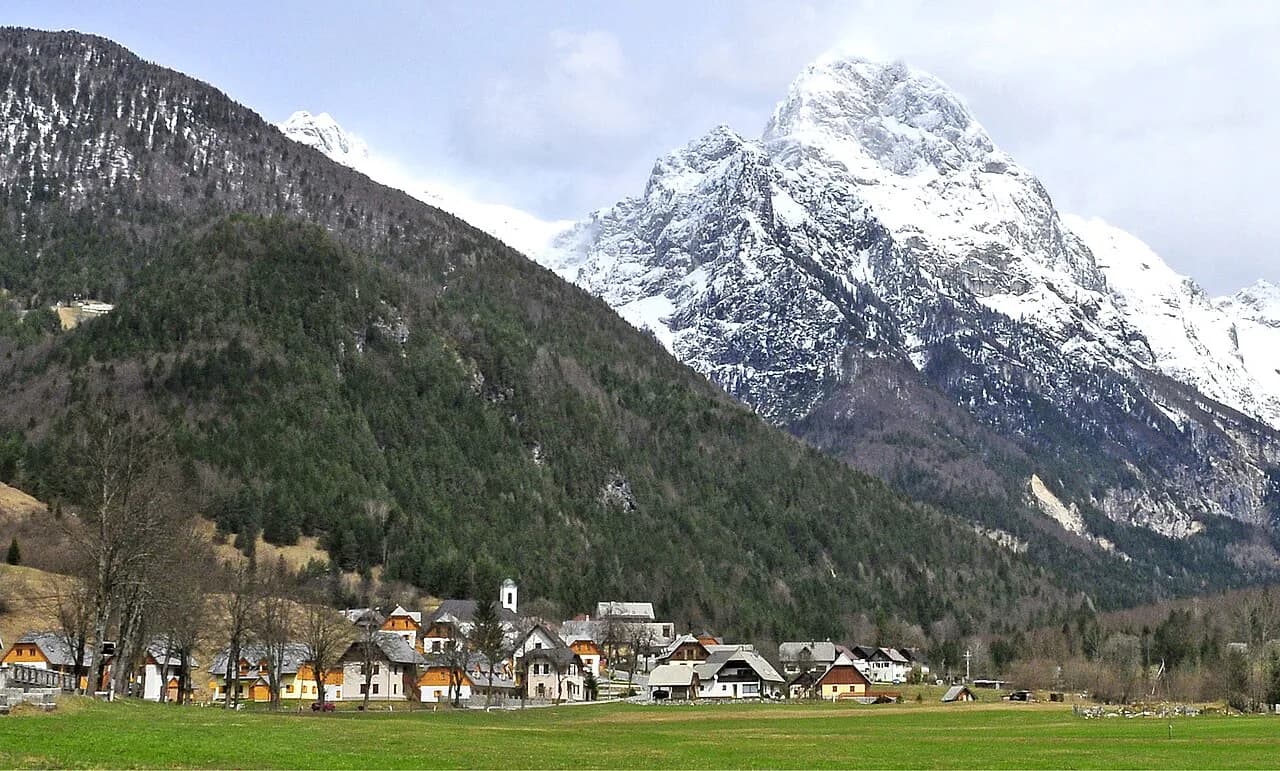
Log pod Mangartom: What to See in the Village Below Mangart

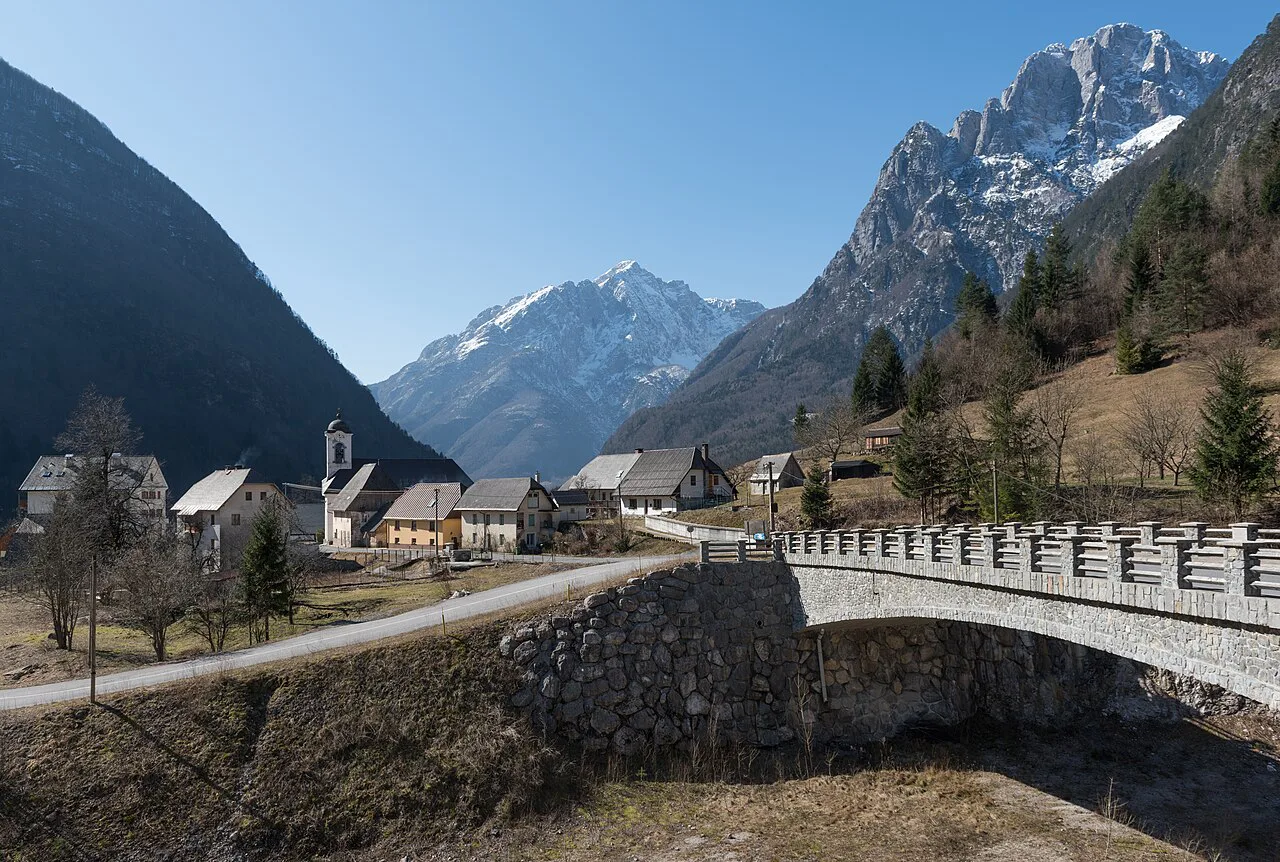
Log pod Mangartom is worth a half-day, not a base: the village holds an Austro-Hungarian military cemetery, the Štoln mine entrance that marks the start of the Walk of Peace, and the church of St. Barbara, all within a short walk of each other. It sits in the Soča Valley near Bovec, on the road that leads up toward Mangart. This guide covers what the village actually contains, how the cemetery and Štoln fit together, and how to reach it and park.
What Log pod Mangartom is and where it sits in the Soča Valley
The village lies in the Koritnica valley, below the Mangart massif that gives it its name. It is made up of the former villages of Gorenji Log and Spodnji Log plus the hamlets of Loška Koritnica, Možnica and Pustina. That scattered layout explains why the sights are spread along the road rather than clustered around one square.
Treat the village as a trailhead base rather than a resort. What it has is World War I heritage, a church and a starting point for the Walk of Peace. Anyone wanting restaurants, shops and evening options should base in Bovec and come here for a few hours, and the Bovec Neighborhoods: 5 Area Guides set out the villages around it so you can pick the right base.
The village's other role is as a gateway to the upper Koritnica. Travelers heading toward the Mangart road or toward the quieter valleys above Bovec pass through here, and the settlement works as a natural pause before the gradient steepens. Farther up the same river, Bavšica: The Quiet Valley Above the Koritnica Near Bovec covers a side valley that pairs with this drive.

The military cemetery and its monument to soldiers facing Rombon
The Austro-Hungarian military cemetery is the reason most visitors stop. More than 800 soldiers of various nationalities are buried here, mostly members of the 4th Bosnian-Herzegovinian Infantry Regiment, and the site is described as one of the best preserved World War One cemeteries in Slovenia. Rows of iron crosses carry the soldiers' names.
The monument shows two soldiers looking toward the top of Rombon, the mountain where most of those buried fell in fighting during the Isonzo Front. Reading the crosses and then the monument in that order makes the layout legible: the graves below, the mountain they face above.
Allow 20 to 30 minutes for the cemetery and monument at an unhurried pace. It is a compact site, so it does not need a scheduled slot, and it pairs naturally with Štoln next door rather than as a separate trip.
Štoln: the mine entrance that starts the Walk of Peace
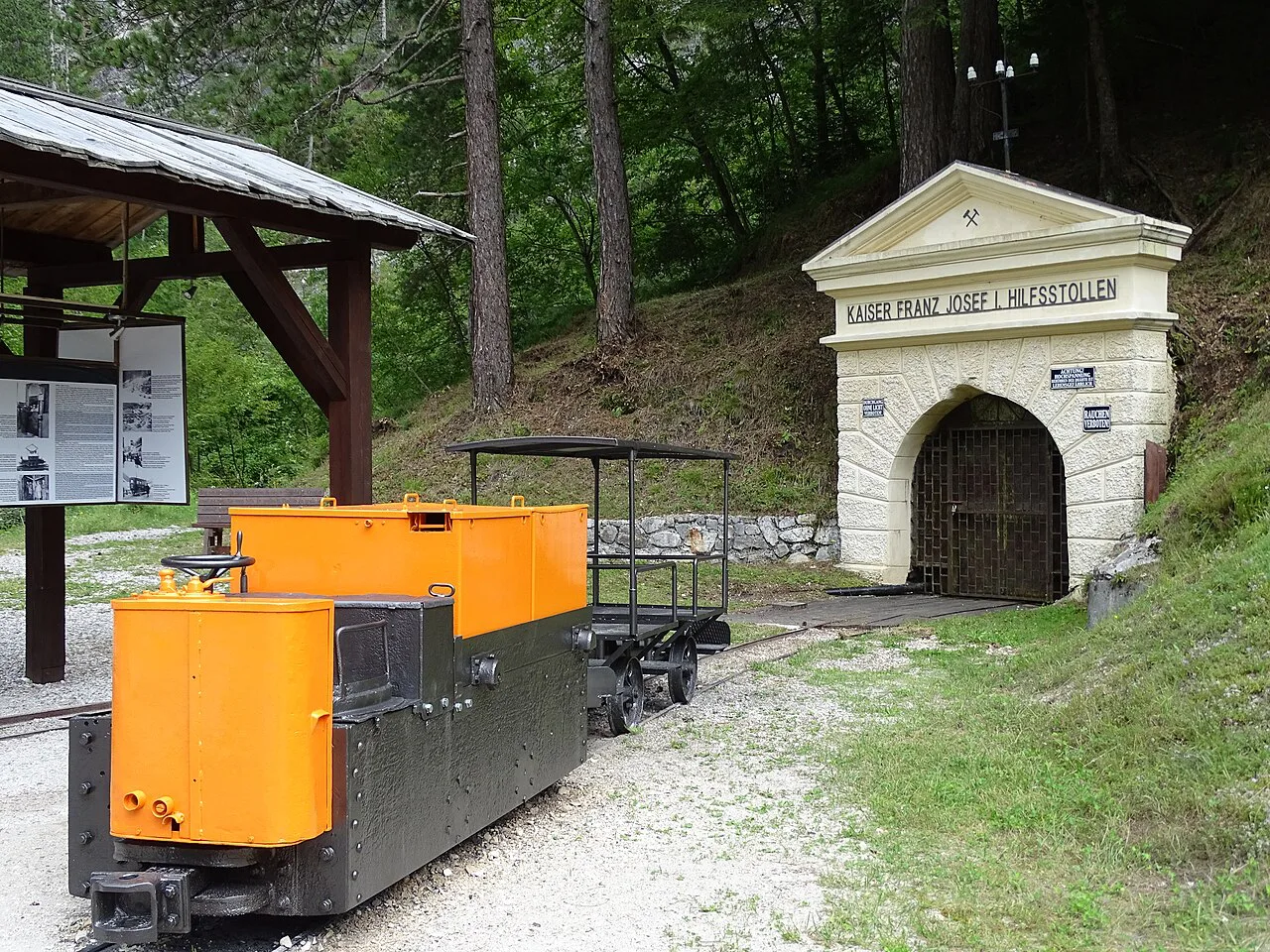
Next to the cemetery lies Štoln, known in German as Hilfsstollen, a renovated entrance to a mining shaft once connected to an abandoned mine at Cave del Predil, on the Italian side. Štoln is the official starting point of the Walk of Peace from the Alps to the Adriatic, the long-distance trail that follows traces of the Isonzo Front.
For most travelers the shaft entrance is a marker rather than a visit: you come to see where the route begins, photograph the portal and read the panels, then decide whether to walk a section. The first stage runs from here toward Bovec via the Koritnica, the Možica valley, Fort Kluže and the outdoor museum Ravelnik.
Guided programs along the route, including ones built around Ravelnik and the Austro-Hungarian positions above Bovec, are organized through the Walk of Peace Visitor Centre in Kobarid on Gregorčičeva ulica. If you want context rather than a signboard, that office is the place to arrange it before you arrive.
The church of St. Barbara and the village core
St. Barbara, patron of miners, stands by the main road opposite the civil cemetery, and the route to Štoln turns off here. The dedication makes sense of the village's mining past and gives the settlement its one clear landmark for orientation.
The village core is thin on services; what you get is the church, the two cemeteries and the road, with houses spread along the valley. Plan on bringing what you need for the visit and treating the stop as heritage rather than as a place to linger over lunch. For a fuller village afternoon, Plužna: A Quiet Bovec Village Near the Virje Waterfall is a short drive away and gives you somewhere to slow down after the monuments.
The mosque that Bosnian-Herzegovinian soldiers built in 1916 and what remains
In 1916 Bosnian-Herzegovinian soldiers built a mosque in Log pod Mangartom, and during the war Muslim graves were marked with niches typical of Muslim tombstones. The mosque is no longer preserved, and old photographs are the record of how it looked.
Come expecting to find no building: what remains is the cemetery, the grave markers and the photographs. Knowing this in advance prevents the most common disappointment at the site, since the mosque is often mentioned alongside the cemetery as if it still stood.

Getting there: the Bovec–Log pod Mangartom seasonal bus and driving on the Mangart road
Public transport to the village is seasonal. The Walk of Peace lists a summer hop-on hop-off service running Bovec–Log pod Mangartom–Mangartsko sedlo, grouped with other summer routes such as Bovec–Vršič–Kranjska Gora and Bovec–Predel–Tarvisio. Outside that summer window, plan on arriving by car.
By car, the village sits on the road from Bovec toward the Mangart saddle, a short drive from Bovec itself. The Mangart road beyond the village is a mountain road whose access varies with season and weather, so confirm conditions with TIC Bovec in Trg golobarskih žrtev before committing to the climb.
Walkers on the Walk of Peace start at the parking area at Štoln and finish the first stage at the parking area in front of the Kulturni dom in Bovec. The GPS coordinates given for the start are 46.404879, 13.596521.
Parking at Štoln and where the stage ends in Bovec
Parking for the cemetery and Štoln is the lot at Štoln itself, which doubles as the trailhead parking for the first Walk of Peace stage. Arriving early matters more in summer, when the hop-on hop-off bus and walkers use the same small area.
If you walk the stage into Bovec, the endpoint is the parking area in front of the Kulturni dom, which puts you in the middle of town rather than back at the village. That means either arranging a pickup or using the seasonal bus to return to Štoln.
Who the village suits and who should base elsewhere
Log pod Mangartom suits travelers interested in World War I heritage, walkers starting or finishing a section of the Walk of Peace, and drivers exploring the upper Koritnica toward Mangart. It also suits anyone who wants a quiet alternative to the busier Bovec center for an hour or two.
It does not suit travelers who want a base with restaurants, shops and evening life, and it is a poor fit for anyone expecting a preserved mosque or a museum in the village. Those travelers should stay in Bovec and treat the village as a stop.
For a different kind of quiet, the valley above the Koritnica offers a comparable pace without the war heritage, and it works well combined with the same drive.
Should Log pod Mangartom be a stop or a base?
Make it a stop. Two hours covers the cemetery, the monument, Štoln and St. Barbara comfortably, and the village gives you the trailhead and the history without the services a base needs.
Sleep in Bovec, come here in the morning before the summer buses fill the Štoln lot, and use the seasonal hop-on hop-off service if you would rather not move the car. Confirm the bus and the Mangart road with TIC Bovec before you set out.
Explore more Bovec guides
Frequently Asked Questions
Can you walk from Log pod Mangartom to Bovec?
Yes. The first stage of the Walk of Peace runs from Štoln in Log pod Mangartom to Bovec, following the Koritnica through the Možica valley and past Fort Kluže and the outdoor museum Ravelnik. It ends at the parking area in front of the Kulturni dom in Bovec, so plan how you will return to your car.
How long does the military cemetery take to visit?
Plan on 20 to 30 minutes. The cemetery and its monument to two soldiers facing Rombon form a compact site, and Štoln sits right next to it, so the two are visited together rather than as separate stops.