
Tartini Square (Tartinijev trg) in Piran: A Visitor's Guide

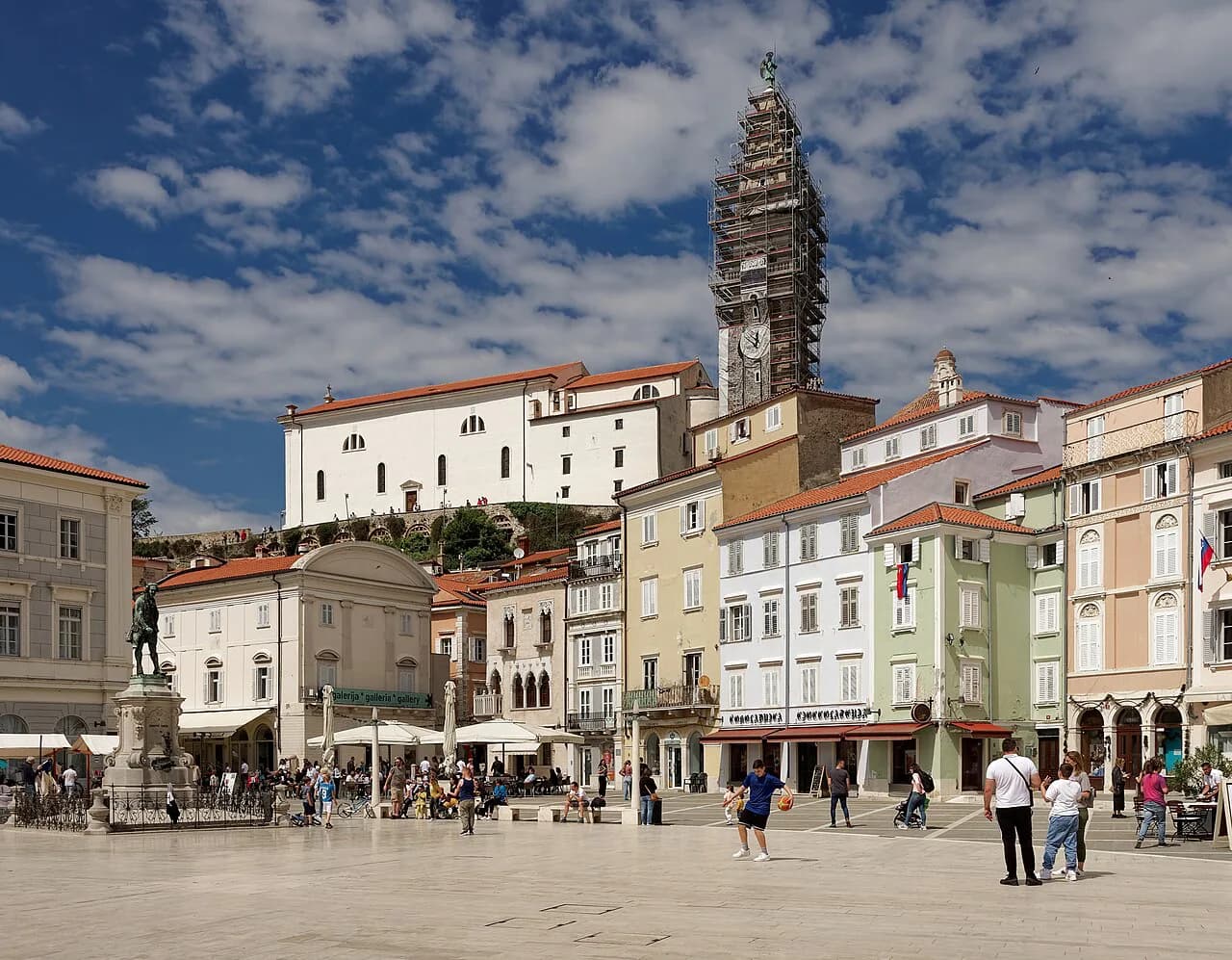
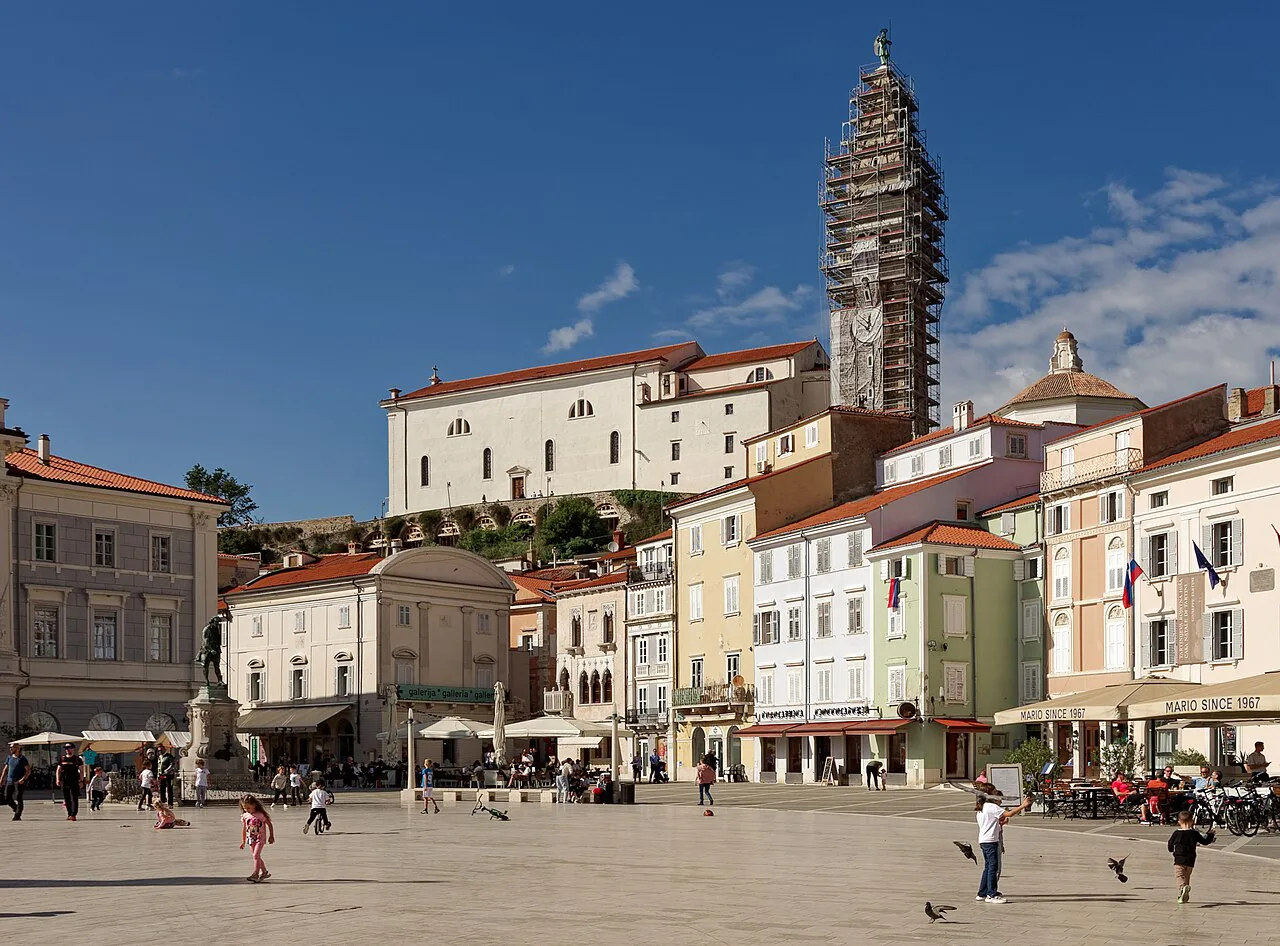
Allow about an hour at Tartini Square (Tartinijev trg), Piran's main square and the natural starting point for the town. It is a traffic-free plaza of white marble paving, ringed by Venetian-style buildings, with a bronze statue of Giuseppe Tartini at its center, cafés and seafood restaurants at street level, and narrow Gothic lanes running off it.
This guide covers where the square sits in Piran, how to reach it from the car parks and shuttle buses, what the shape of the paving explains, the buildings that frame it, and how to link it to the Church of St. George and the town walls.
Where Tartini Square sits in Piran
The square occupies the center of Piran, a medieval walled town on the cape of the Piran peninsula in Slovenian Istria. Its official address is Tartinijev trg 1, at the low, flat heart of the peninsula. Everything in the compact old town funnels into it, which is why it works as a meeting point rather than a sight you tick off.
The square sits inside Piran's pedestrian zone. Cars are not allowed within the square, so you arrive on foot through the lanes. Treat it as the point where you orient yourself: the waterfront side faces the Adriatic, the inland side climbs toward the hill and the church above.

How to reach the square: car parks and the free shuttle buses
Visitors park outside the old town and ride in: free shuttle buses run between the car parks and the town, which keeps cars out of the square. Use the shuttle rather than guessing at street parking inside the peninsula, and plan your arrival so you are not hauling luggage through the lanes at midday.
Once the shuttle drops you, the last stretch to Tartinijev trg is a short walk on flat paving, so the square is easy to reach with a day bag. Because the town is small and the square central, it also makes a sensible place to start any walk through Piran before heading uphill toward the church and walls, covered in the wider set of Piran Attractions guides.
Why the square is oval: a filled harbor and an old tram terminus
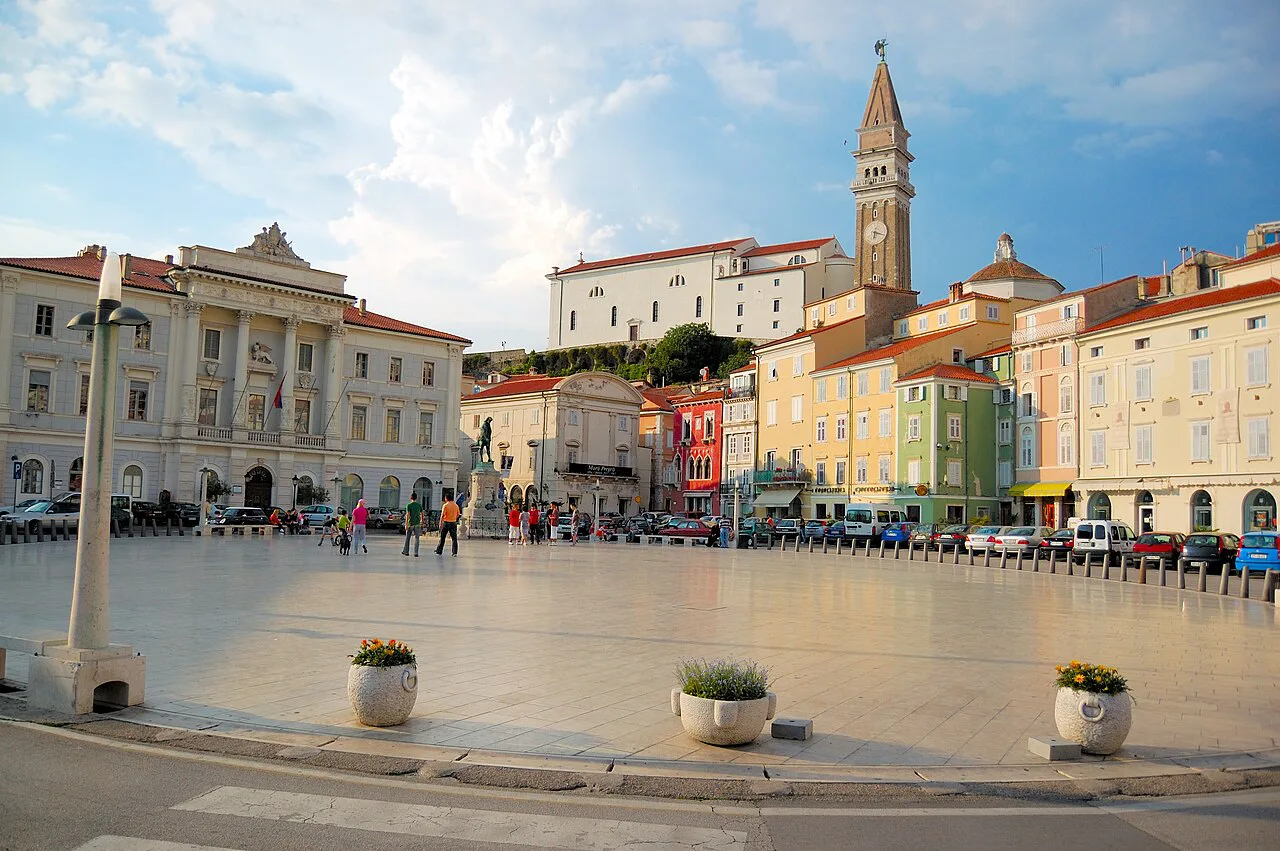
The square began as an inner dock for small fishing boats outside the medieval city walls, and buildings and palaces had already crowded around the water before the dock was filled in 1894. That is why the open space reads as a room carved out of a much older street plan.
The rounded shape is a leftover of transport rather than design. An electric trolleybus ran between Piran and Lucija from 1909 to 1912 with its turning tracks laid in the square, and a tram followed until 1953. The white marble pavement traces that roundabout, and the elliptical form reflects the square's past as a tram terminus.
The current layout was designed by architect Boris Podrecca in the 1980s, so the surface you see is a late-20th-century reworking of an older footprint. Walk the outer curve of the marble first, then cut across the middle toward the statue; the paving is the quickest way to read how the harbor and tracks once sat.
The Tartini statue and Giuseppe Tartini
The bronze figure at the center is Giuseppe Tartini, the violinist and composer born in Piran, and the square takes his name. The monument was erected in 1896, and the sculpture is by the Venetian sculptor Antonio Dal Zotto. It is the square's anchor point: meet under it and use it to keep your bearings when the lanes start to look alike.
The statue stands in the open square among the benches, cafés and passers-by, so expect other people using the same few meters for photos. Give the monument a wide berth if a performance or event is using the space around it.
Buildings around the square: Town Hall, Venetian House and St. Peter's
Look up from the pavement and the square's edges do most of the work. The neoclassical Town Hall faces the open space, the Gothic-style Venetian House stands among the surrounding buildings, and the Church of St. Peter, which dates to 1818, sits close by. One building on the square keeps its original exterior from the rebuild that followed the harbor's filling in.
The Venetian house Piran is known for is worth a closer look from the outside for its Gothic window detail, and it sits within a minute of the marble. A slow circuit between the Town Hall frontage and the surrounding façades takes in the architecture without entering anything.
Cafés, seafood restaurants and shops around the square
The ground floors facing the marble hold cafés, seafood restaurants and shops selling local produce, which is why the square fills with people sitting rather than walking. Check the menu board at the door before you commit, since prices and hours are set by each business and change with the season.
Shopping here is small-scale: local produce and everyday goods rather than a mall. Come earlier in the day for a quiet browse before the benches and café terraces fill, and keep purchases light if you are continuing uphill to the church and tower.
Events, concerts and street performers
The square is Piran's social and cultural heart and a regular gathering place for events as well as everyday life. Concerts and other events take place here regularly, and street artists and performers are a common sight around the marble. A mid-morning visit feels like a town square; an evening with a stage or a crowd feels entirely different.
If a performance matters to your trip, check the town's notice boards and local listings once you are in Piran rather than building a schedule around a date in advance. Otherwise, treat any music or crowd as a bonus and keep your plan flexible enough to linger.
How long to allow and when it is busiest
An hour covers the square itself: a circuit of the façades, a stop at the Tartini statue, and a coffee on the marble. Add time if you plan to eat, and more if you want to sit through a performance. Because the square is a meeting point, it is busiest when shuttle arrivals overlap, so earlier or later tends to be calmer.
Pair the visit with the narrow Venetian Gothic alleyways radiating from the square, which are part of the same short walk. Budget the square and lanes as one block, then climb.
Nearby: Church of St. George, the bell tower and the town walls
Above the square, the Church of St. George has frescoes, marble altars and a large statue of St. George slaying the dragon. It was originally built in the 12th century, expanded in the early 14th century and given a Baroque reworking in 1637. Set in front of it, built separately in 1608, is the bell tower, which rises 46.45 meters and is topped by a weather vane in the form of a 3.6-meter Archangel Michael.
Climbing the tower means 146 steps to the top, past four bells and out to a wide view over the town and coast. From Tartini Square the route up is short but uphill, so do the square first, then the church and tower, and keep the walls for last.
Piran's town walls were built in stages from the 7th to the early 16th century and expanded between 1470 and 1534 to enclose the whole peninsula. Sections of wall and seven gates still stand through the town, and you can climb to quite a height; the view, rather than the masonry, is the reward. Check access arrangements at the site, since the walls are managed separately from the square.
Two other options sit within an easy walk when the square is done: the maritime museum Piran for a rainy hour, and the aquarium Piran for a short stop with children. Farther out, the Forma Viva Portorož sculptures on the Seča peninsula make a half-day extension along the coast.

Should Tartini Square be your first stop in Piran?
Yes, if you want the shortest possible orientation to Piran. Arrive by shuttle from the car parks, walk the oval of marble once, find the Tartini statue, and use the cafés and lanes around it to decide what comes next. The square itself is quick; the value is in how easily it connects to the church, the 146-step tower and the walls above.
Come early or late for calm, and check event notices and site arrangements on the day. For everything else in town, from the Punta cape to fuller lists of things to do in Piran, the surrounding guides pick up where the square leaves off.
Explore more Piran guides
Frequently Asked Questions
Do I need a ticket for Tartini Square?
The square is an open public space you walk into from Piran's lanes rather than a gated sight. The bell tower and town walls above it are separate, and their arrangements are posted where access is sold.
Can you drive to Tartini Square?
No. Cars are not allowed within the square, and Piran's center is a pedestrian zone. Visitors park outside the old town and use the free shuttle buses that run between the car parks and the town.
Why is Tartini Square shaped like an oval?
The rounded form follows the square's history as a filled-in harbor and later an electric trolleybus and tram terminus. The white marble paving traces the turning circle, and the current layout was designed by architect Boris Podrecca in the 1980s.