Painted Beehive Panels: What They Show and Where to See Them in Slovenia
Painted beehive panels are Slovenia's folk-art hive fronts. Learn the scenes they show, the Selca Workshop painters, and where to see the panels.
On this page
Painted beehive panels are the decorated front boards of traditional Slovenian hives, and they are worth seeking out because of the scenes rather than the woodwork. Within European folk art, painting on frontal beehive panels is described by the Škofja Loka Museum as a peculiarity, developed in a small territory across what is now southern Austria and central Slovenia. This guide explains what a panel actually is, what the pictures show, who painted them, and which museum collections hold examples you can study up close.
The short answer for a traveler: treat the panels as a small, specific branch of Slovenia culture rather than a general souvenir theme, and plan around the two museum collections that hold documented examples. The painting tradition belongs with other rural craft subjects in the country, from hayracks to beekeeping itself, so it rewards a little context before you look.
What a Painted Beehive Panel Is
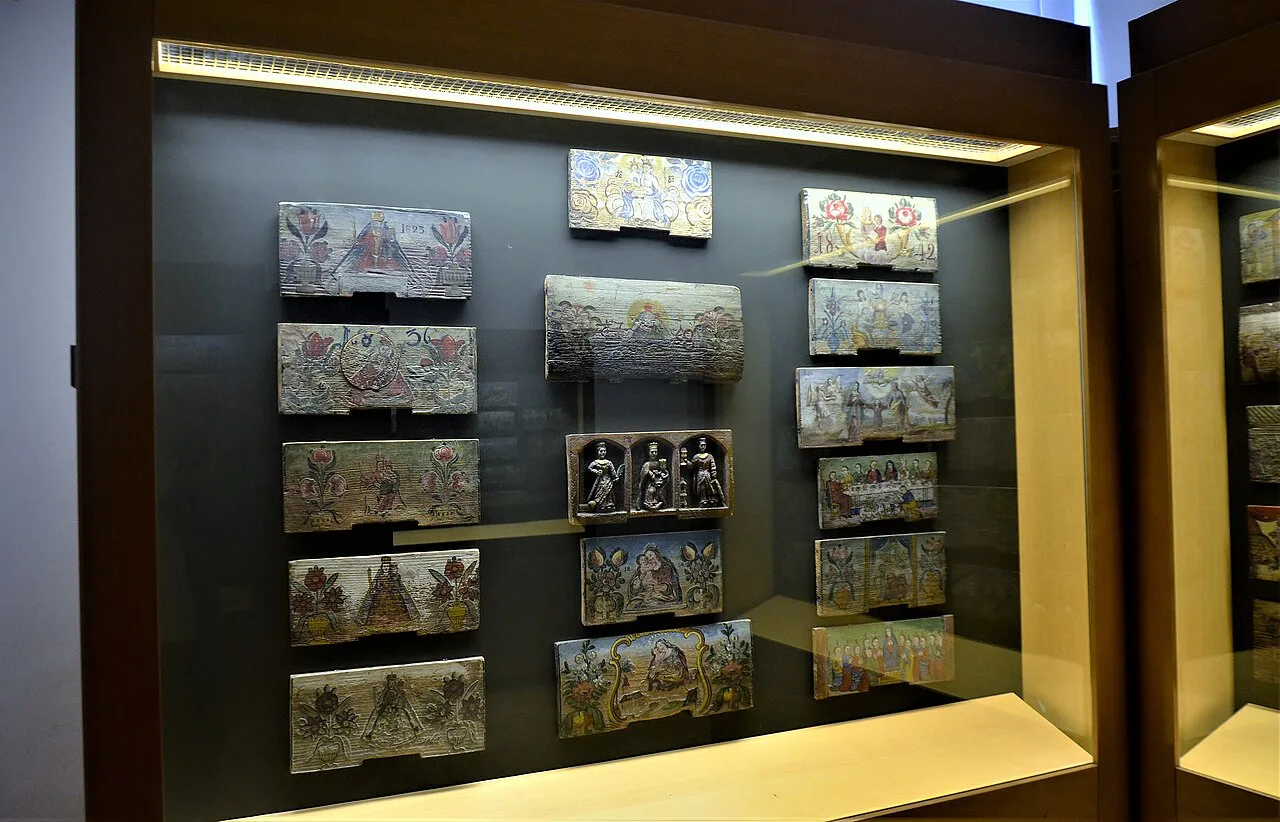
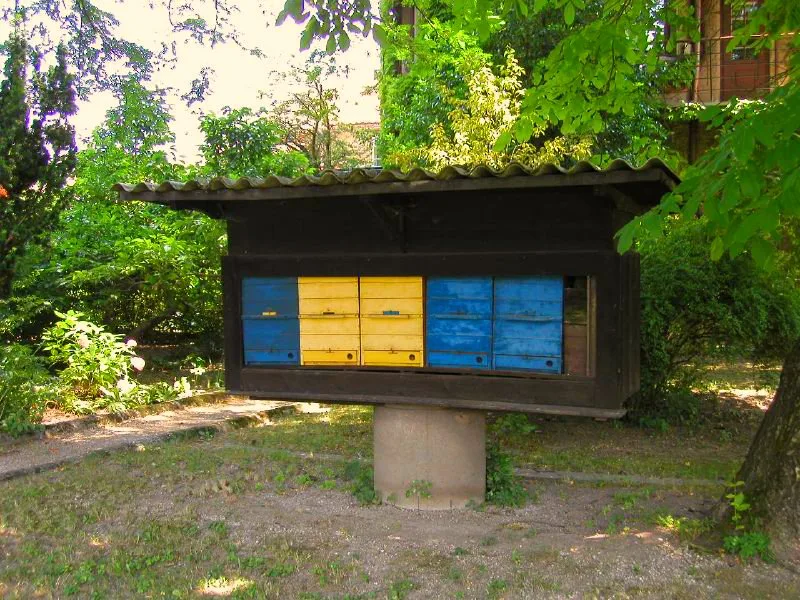
A beehive panel is an elongated rectangular board fixed to the front of a wooden hive, with an opening cut so the bees can come and go. That type of hive is called a kranjič, the traditional Carniolan beehive, according to the Škofja Loka Museum. The panel is the painted face of the hive, not a separate picture hung on a wall, which is why the format is long and narrow rather than square.
Because the panel sits on the hive itself, the paintings were made to be seen at close range by the beekeeper and by visitors walking between the hives. When you look at one in a museum case, note the proportions: the scene is squeezed into a horizontal strip, so painters arranged figures in rows and kept backgrounds sparse. That constraint explains much of the style, from the flat color to the way clothing carries the story.
Where the Tradition Grew
Painted frontal panels originated in the mid-18th century in a compact area spanning southern Carinthia, northwestern Styria and the central and northern parts of Carniola, an area inhabited by the Slovenian population. The art peaked in the 19th century and persisted in some places until the end of World War I. That geography matters for a traveler because the panels belong to a borderland rural belt, not to one single town, and the museums that hold them sit within or near that belt.
Religious and Secular Scenes
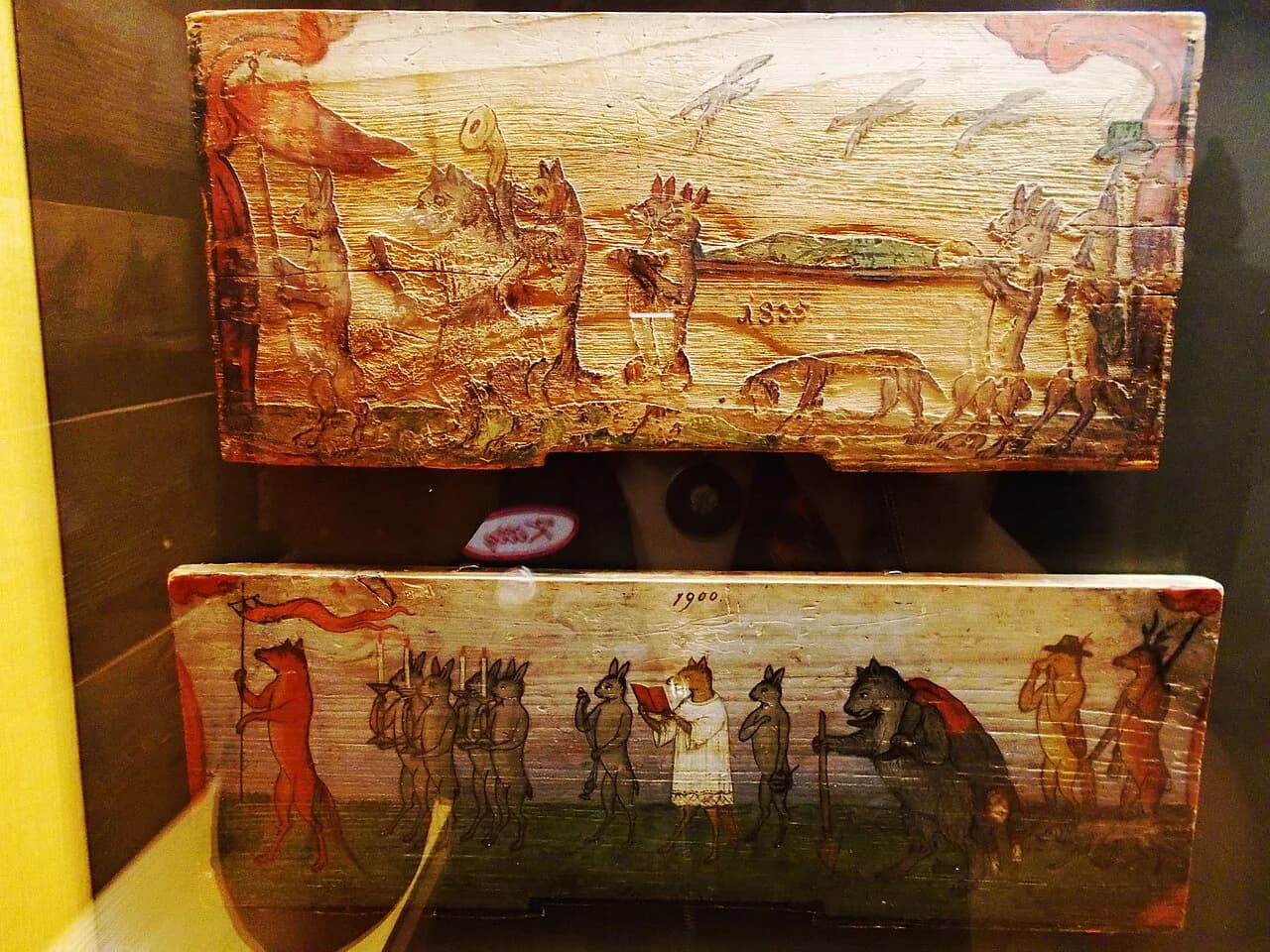
Across the tradition, more than 600 different subjects are recorded, divided into religious and secular scenes, with the secular ones split further into imaginary and realistic subjects. The Škofja Loka Museum notes that painted beehive panels are the only genre within folk art to carry both religious figurative subjects and secular ones. So a row of hives could show Noah's ark beside a scene of two farmers arguing over a cow, which is precisely the appeal.
Painters drew their subjects from Holy cards, prints, newspaper and book illustrations, and from earlier panels, or invented scenes outright. That borrowing is why the same composition turns up on panels held by different museums today. If you are comparing examples, look for repeated figures and settings before assuming two panels come from the same hand.
The Selca Workshop: Andrej and Marija Pavlič
The best-documented painters from the Škofja Loka area were Andrej Pavlič (1790–1873) and his daughter Marija (1821–1891), known locally as Blaževčeva or Podnartovčeva Micka, working from Selca in the Selca Valley. The pair specialized in painted beehive panels along with glass paintings, panel paintings, shrines, clocks and chests. Naming them matters: these are individual artists with dates, not anonymous village decoration.
At the Selca Workshop, beekeepers could choose from 141 painted subjects, 71 religious and 70 secular. Marija Pavlič transferred the designs onto the panels using templates, and the workshop worked in red, Indian red, brown, blue, ochre and green in various shades. That palette, warm reds against ochre and green, is a quick way to recognize the workshop's output in a display case.
How the Panels Were Made and Sold
The workshop's repertoire went beyond the familiar religious scenes. It introduced subjects such as the initiation of young Indians from the Mandan tribe, Indians kidnapping two white girls, two farmers fighting over a cow being milked by a counsel, and a Turk smoking a pipe. Those choices show painters responding to printed material circulating at the time rather than working only from church imagery.
Peddlers carried the panels through the Selca Valley and the Sora Plain, into Bohinj and to the market in Kranj. One seller, Oroslav Dolenc, a candle- and honeybread-maker from Ljubljana, sold 500 Selca Workshop panels a year. That distribution explains why examples turn up in collections well beyond the workshop's home valley, including Bohinj, which travelers often visit for the lake.
Price once tracked detail: a panel cost more the more people were depicted, starting between three and five Kreutzer and later rising to ten Kreutzer. Those are historical figures in a currency long out of use, not what you pay today. The takeaway is that a busy, multi-figure scene represented more work, so a sparse panel with one figure and a plain background is a simpler object than a crowded biblical narrative.
Where to See Painted Panels in Slovenia
The Škofja Loka Museum has an exhibition page on the Selca Workshop's painted beehive panels, with individual panels photographed and described scene by scene. The page does not confirm current display status, so check with the museum before you build a day around it. Škofja Loka itself is a compact town that pairs easily with the museum visit.
Documented Selca Workshop panels are held by the Museum of Apiculture Radovljica and by the Slovene Ethnographic Museum, including dated examples such as Noah's Sacrificial Offering from 1886 and The Wedding at Cana in Galilee from 1882, both held at Radovljica. If a specific panel is your reason for going, contact the museum to confirm it is on display rather than in storage. For the wider picture of beekeeping heritage in Slovenia, the Carniolan bee and its history are worth reading up on first.
A separate option is a Koželj family beekeeping collection featured by People Are Culture as a place to see painted beehives and the tradition behind them; the article sits behind a membership wall, so verify current visiting arrangements and location directly before traveling. Treat it as a bonus rather than the backbone of a panel-focused day.
What to Look For Up Close
The faces on Selca Workshop panels are typified, and each figure's role is defined by nothing but clothing and the chore being shown. Read the panel that way: a hat, an apron or a tool tells you who the person is, because the face will not. This is also where the Slovenian folk costume details you may know from other contexts reappear in miniature.
Expect scenes you would never find on a church fresco, from farmyard quarrels to depictions of distant peoples drawn from prints. Because painters copied from circulating images, mistakes and odd details are common and are part of the interest. Compare the figures' hands and the way animals are drawn across several panels in one case and the copying becomes obvious. The same habit of copying familiar forms onto household objects runs through other Slovenian traditions, which is why a panel reads as folk art rather than as a printed picture.
Buying a Panel Today
Modern reproductions are widely sold, and the construction matters more than the picture. AZ Hives North America states plainly that its hive front boards are made with an overlay process and are not painted, and it lists them at $28.00 each. If you want actual brushwork, that is the question to ask before paying.
Hand-painted panels are sold too. Slovenier.com lists painted beehive panels measuring 25 by 12.5 by 1.5 cm in three motifs, Animals, Beekeeper and Queen, each at 30.00 EUR, and describes its panels as artistically painted front boards typical of Slovenia and not found elsewhere. For a traveler choosing between the two, a reproduction is a decor piece and a painted panel is a craft purchase, and the price gap usually reflects that.
If folk art is part of why you came, panels sit naturally alongside other Slovenian souvenirs tied to specific regions and crafts, so weigh a panel against the other things you might carry home. Size is worth checking against your luggage before you commit: a 25 cm board is easy to pack, but larger pieces are not.
Which Panel Collection Should You Visit?
Choose the Škofja Loka Museum exhibition if you want the Selca Workshop explained as a body of work, and add Radovljica if beekeeping heritage is the draw. Both give you painted panels in context, which no shop display can. Confirm opening hours and admission on the day you plan to go, since those details change.
If you only have time for one stop, pick the collection nearest your route and spend the saved hour reading the scenes closely rather than rushing between towns.
Explore more Slovenia guides
Sources
Notes for your Slovenia trip
Optional updates to our Slovenia place guides.
You might also like
Continue reading
More guides you'll find useful