Slovenian Folk Costume: The Regional Types Behind the National Look
Slovenian folk costume spans Mediterranean, Alpine and Pannonian styles, with the Gorenjska dress read as the national look. Here is how the regions differ.
On this page
The Slovenian folk costume most travelers recognize is the Gorenjska, or Upper Carniola, dress, which is considered the national dress of Slovenia and now appears mainly on folklore singers and dancers. Behind that single look sit three original clothing traditions — Mediterranean, Alpine and Pannonian — that developed in different parts of the country and still shape regional costumes. This guide explains what the costume is called, how the regional types differ, and which parts of the outfit are sometimes rather than always worn.
What the Slovenian folk costume is called: narodna noša and the regional noše
The Slovenian national costume is the narodna noša, and the regional versions are the noše. The same clothing traditions carry a separate label, the črna noša or dark costume, a stylized black outfit that sits apart from the regional dress. Slovenian folk costuming experts divide the historic material into three original categories: Mediterranean, Alpine and Pannonian.
Those categories describe clothing styles that differed from one another before they converged into a national form. The distinctions matter to anyone trying to read a costume photograph or a festival outfit, because a single garment can point to a region rather than to the country as a whole. Many Slovenians know little about this historical clothing culture, even though individual pieces such as shawls, chains and headpieces survive in family collections, and the same is true across much of Slovenia culture more broadly.
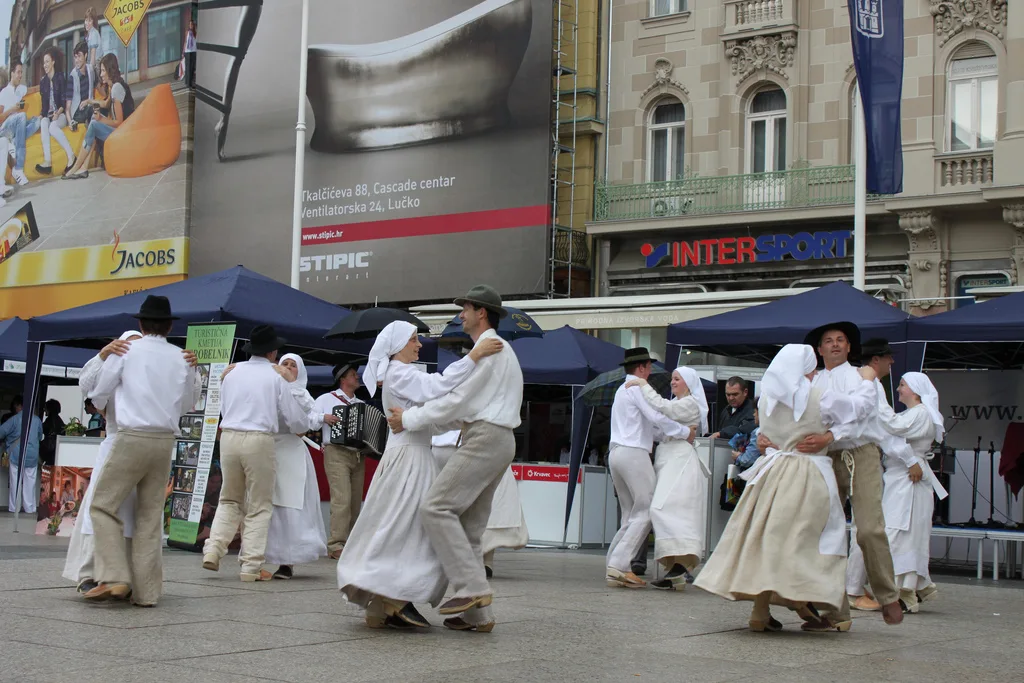
The three original costume categories: Mediterranean, Alpine, and Pannonian
The Mediterranean, Alpine and Pannonian grouping is the frame to use when you look at Slovenian dress. Each category reflects a different part of the country's clothing geography, and the styles evolved separately before feeding into the nationalist movement that produced the narodna noša. Treat the categories as a way of organizing regional outfits, not as three fixed uniforms.
For a visitor, the practical value is orientation: the Alpine traditions belong to the mountainous north and west, the Mediterranean ones to the Littoral, and the Pannonian ones to the eastern lowlands. A costume described as Alpine is therefore not simply a variant of the Gorenjska dress but part of a broader clothing family. Knowing which family a piece belongs to tells you more than the color of the apron.
Why the Gorenjska (Upper Carniola) costume became the national dress
The Gorenjska costume, from Upper Carniola, is the best known of the Slovenian regional outfits and is considered the national dress. That status came from familiarity rather than from any single official decision: it is what people generally picture when they think of Slovenian costume. It also exists in several variants, so two Gorenjska outfits can look noticeably different.
The Gorenjska style now belongs mostly to performance. It is used by folklore singers and dancers, which is why the version most travelers encounter is a stage outfit rather than everyday dress. When you see a group in matching Gorenjska costume, you are looking at a revival tradition that keeps several recognized variants in use.
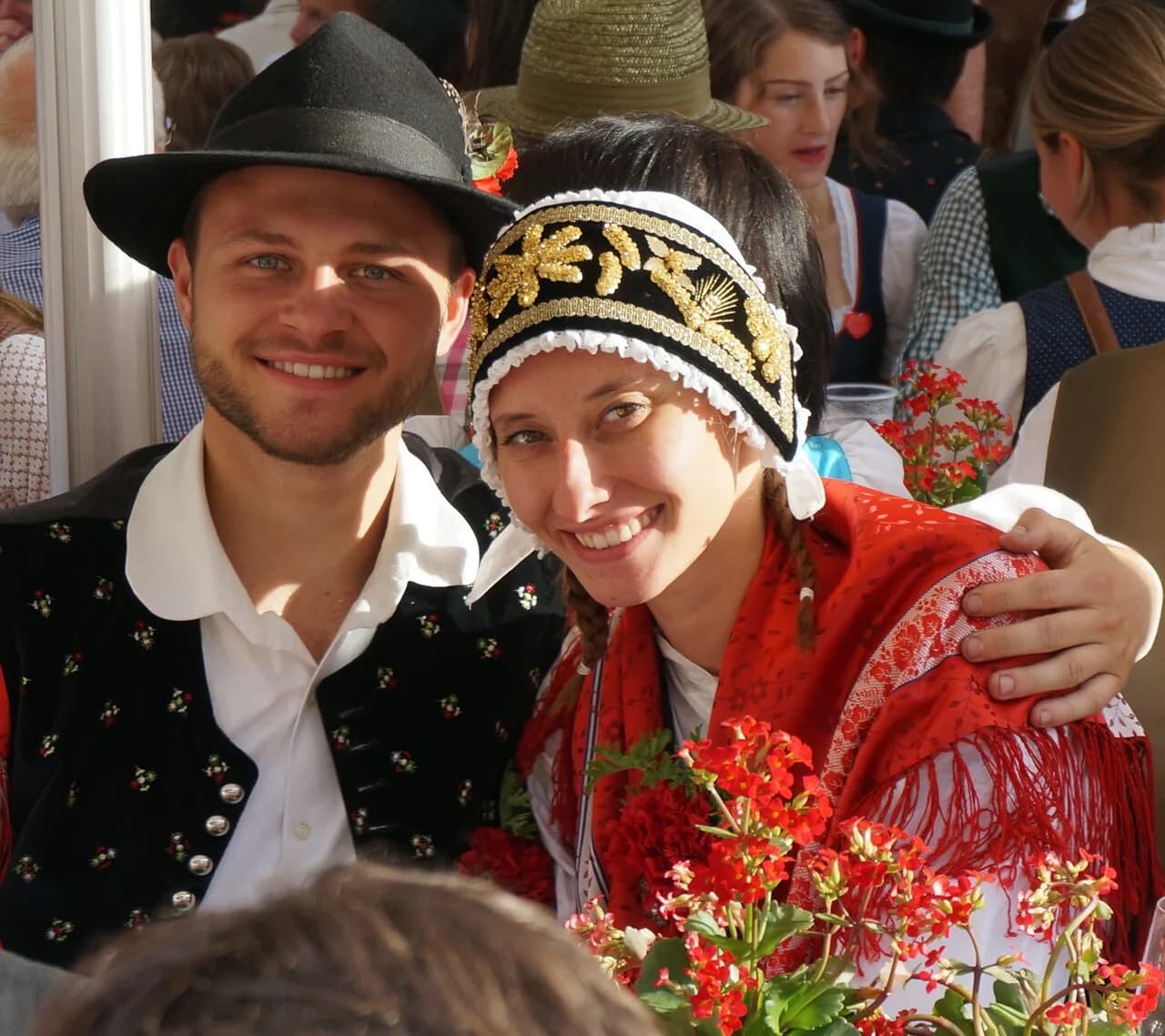
What the Gorenjska women's costume includes: the starched white kerchief and the Spencer jacket
Two optional elements define the Gorenjska women's outfit. Sometimes a Spencer jacket is worn as part of the costume, and sometimes a large starched white kerchief is worn with its ends tied on top of the head instead of the distinctive headdress. Because both are variants, an outfit without the jacket or with the kerchief still reads as Gorenjska.
The headwear is the clearest signal of which variant you are seeing. The kerchief worn over the head, tied at the top, replaces the headdress in one version of the costume, while the Spencer jacket changes the silhouette of the upper body. Look at the head and shoulders first when identifying a Gorenjska outfit in a photograph or at a performance.
Costume across the regions: Ljubljana, Dolenjska, Notranjska, Primorska, Štajerska, Koroška
Ljubljana has costumes associated specifically with the capital, distinct from the Gorenjska dress. South of it, Dolenjska, or Lower Carniola, has a somewhat different costume in its northern parts, while costumes from south-central Dolenjska resemble those just across the Croatian border. That cross-border similarity is a useful reminder that regional dress follows geography rather than modern national lines.
Notranjska, or Inner Carniola, has left very little remembered costume. What survives comes from around Vrhnika in the north, from Viševek in the southeast, and from the Brkini Hills in the southwest, where the dress looks Balkan and close to neighboring Istria. Primorska, the Littoral, is the westernmost region, and most of it borders Italy rather than the Adriatic.
In Štajerska, or Styria, the costume tradition runs alongside the Štajerska region's own history, and Koroška, or Carinthia, lies mostly in Austria with a small Slovenian part. The Meža Valley, Mežiška dolina, lies within Slovenia and has its own dance and costume tradition. Slovenian dress therefore extends beyond the current border into Austria and Italy, which is why so many named costume areas sit partly outside the country.
Bela Krajina's all-white linen costume and the later black city costume
In the southeast corner of Dolenjska, around Črnomelj, lies Bela Krajina, White Country, where the costume is almost entirely white linen. The apparent simplicity is misleading, because the construction and sewing details are complex. Around Podzemelj, some embroidery adds decoration to the all-white outfit.
Bela Krajina's tradition has two stages. Later, for special occasions, people in the region would put on a city-type outfit known locally as the black costume. That pairing makes Bela Krajina a compact case study in how regional dress gave way to formal town clothing for events while the white linen remained the signature look.
The Soča valley, Gorica, and the Resian valley on the Italian side
North of Gorica, the Soča valley, Soška dolina, runs roughly parallel to the Italian border, and the costumes there reflect that frontier position. Near Gorica, the costume worn by folk dance groups representing the area is the version usually seen, including in Solkan on the edge of the city. The most distinctive area is Val Resia, Dolina Rezija, which lies entirely on the Italian side near the Austrian border.
Resia is a special case within the Slovenian costume map. The local dialect has its own orthography and is not intelligible with standard Slovenian, and the people there consider themselves a distinct ethnicity. That means a Resian outfit belongs to the wider family of Slovenian-related dress without belonging to Slovenia as a state, which is exactly the kind of distinction the regional categories help clarify.
What the Črna noša and the Narodna noša mean today
The narodna noša is the national costume, and the črna noša is the stylized dark costume that developed alongside it. Both are better understood as constructed national forms than as everyday regional clothing. The regional noše supply the details, while the national versions supply a shared, recognizable image.
The words authentic and stylized matter when you buy or borrow an outfit. A stage or event costume assembled for a performance is not the same object as a documented regional piece with a known time frame and owner. If you are handling family pieces, note the provenance, because that information is what makes a garment useful for reference and reconstruction.
Where Slovenian folk costume appears now: folklore singers and dancers
Folklore singers and dancers are where most travelers will see the costumes in use. The Gorenjska dress in particular is kept alive by performance groups rather than by daily wear. Look for dance ensembles and cultural society events rather than expecting costume in ordinary street life, in the same way that other Slovenian traditions survive through organized observance.
Costume research also runs through institutions and expert practitioners. Slovenian folk costuming specialists work with folklore groups, researchers, choreographers and seamstresses in Slovenia and abroad, and their public talks are geared to people with heirloom pieces as well as curious beginners. Check the organizers' own pages for any current program rather than relying on a past listing.
The national costume in diaspora communities, in Cleveland and elsewhere
Slovenian communities abroad hold costume material of their own. In Cleveland, historical pieces dating from before the 1940s are known to exist in family hands, and public costume sessions there have invited people to bring heirlooms so they can be photographed for reference and reconstruction. The focus falls on authentic accessories brought from Slovenia, including shawls, chains and headpieces such as the avba, along with kerchief pieces like the peča or ahtah.
A Cleveland presentation on the regional and national costumes, held in 2023, treated the three original categories as its organizing frame and was offered as a free event with an online stream. Treat that as a record of how diaspora groups teach the subject, not as a current schedule. Anyone planning around a similar event should confirm the details with the hosting organization.
How to read a Slovenian costume correctly
Start with the category, then the region, then the variant. An outfit is Alpine, Mediterranean or Pannonian before it is Gorenjska, and the Gorenjska style is itself a set of optional combinations — Spencer jacket or not, starched white kerchief or the headdress. Slovenian place names and their diacritics are worth keeping straight, since Dolenjska, Notranjska and Primorska each point to different clothing traditions.
If you want to see costume in person, follow folklore dance and singing groups and cultural society announcements, and check the host's own page for programs. If you are working from family pieces, record what you know about their age and ownership before anything else, because that context is what turns an old garment into usable evidence.
Explore more Slovenia guides
Sources
Notes for your Slovenia trip
Optional updates to our Slovenia place guides.
You might also like
Continue reading
More guides you'll find useful